Introduction
Sensible Agent Review: Artificial Intelligence has rapidly evolved from simple voice assistants to complex systems capable of understanding human behavior and context. While tools like Siri, Alexa, and Google Assistant have become household names, their reliance on voice commands limits their usefulness in dynamic, real-world environments. As we enter the age of augmented reality (AR), the need for more intuitive, socially aware AI assistants becomes critical.
This is where Sensible Agent, a research prototype unveiled at UIST 2025, offers a glimpse into the future. Designed to operate within AR environments, Sensible Agent doesn’t wait for commands—it anticipates them. It’s proactive, context-aware, and capable of adapting its communication style based on your surroundings. In this review, we’ll explore how Sensible Agent works, its key features, real-world performance, and its potential to reshape the way we interact with technology.
What Is Sensible Agent?
Sensible Agent is an experimental AR assistant that aims to eliminate the need for constant voice interaction. Instead of relying on explicit commands, it uses a combination of gaze tracking, gesture recognition, hand availability, and environmental noise detection to determine how and when to assist the user.
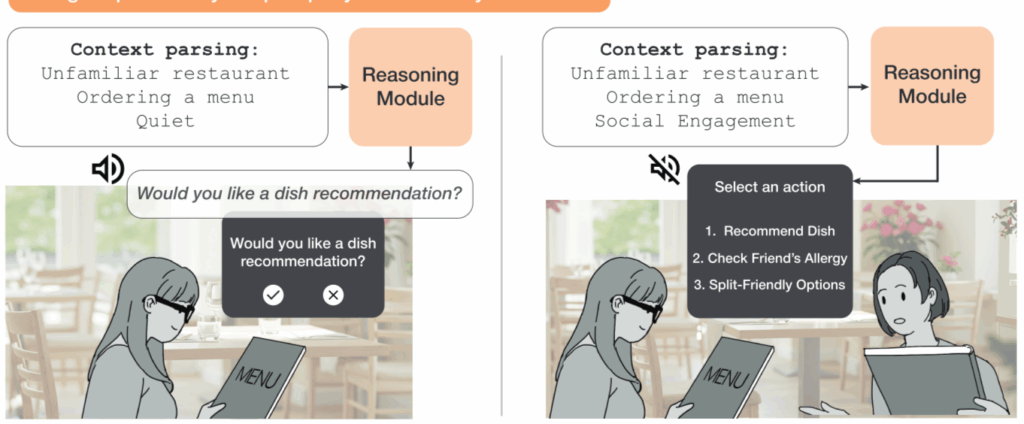
Imagine walking through a museum and simply looking at an exhibit—Sensible Agent can detect your gaze and automatically provide relevant information. Or picture cooking in a busy kitchen, where your hands are occupied and the environment is noisy. Rather than requiring a voice command, the assistant might respond to a head nod or display visual cues to guide you through the recipe.
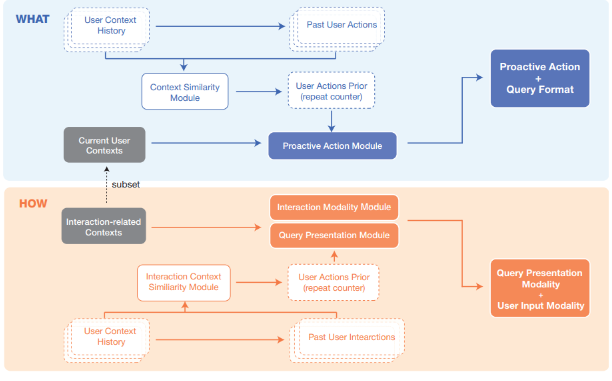
This shift from reactive to proactive assistance is what makes Sensible Agent revolutionary. It’s not just an AI tool—it’s a socially intelligent companion.
System Architecture: How Sensible Agent Works
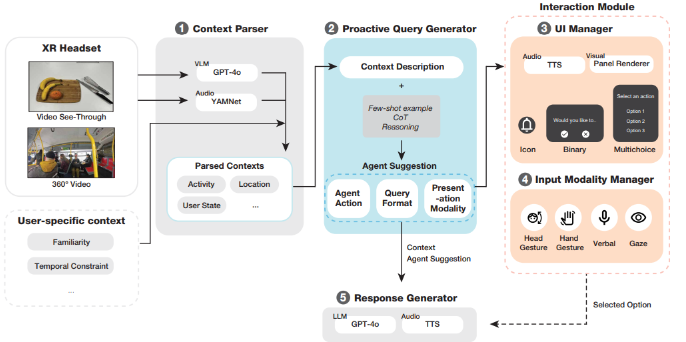
The assistant is built on Android XR and WebXR platforms, and its architecture is divided into four interconnected modules:
1. Context Parser
This module uses a Vision-Language Model (VLM) and audio classification tools like YAMNet to analyze the user’s environment. It can detect whether the user is in a quiet room, a noisy street, or a crowded store, and adjust its behavior accordingly.
2. Proactive Query Generator
Once the context is understood, this module determines what kind of help to offer. It uses reasoning techniques such as chain-of-thought (CoT) and few-shot learning to generate relevant suggestions without needing a prompt.
3. Interaction Module
This component decides how to deliver the information—through voice, visuals, or gestures. It also manages input methods, allowing users to respond via gaze, head movements, or speech.
4. Response Generator
The final module creates natural-sounding replies using a large language model (LLM). Depending on the situation, the response may be spoken aloud, displayed visually, or conveyed through subtle cues.
Together, these modules enable Sensible Agent to function as a seamless, adaptive assistant in real-world settings.
Feature Comparison: Sensible Agent vs Traditional AR Assistants
To better understand Sensible Agent’s capabilities, let’s compare it with conventional AR assistants:
Feature | Sensible Agent | Traditional AR Assistants |
|---|---|---|
Input Methods | Gaze, gestures, head nods, voice | Voice only |
Context Awareness | High (uses cameras and audio sensors) | Low (relies on user commands) |
Communication Style | Adaptive (visual, audio, gesture-based) | Static (mostly voice-based) |
Proactive Suggestions | Yes | No |
Social Intelligence | Yes | Limited |
Multimodal Interaction | Fully supported | Rarely supported |
This table highlights how Sensible Agent offers a more flexible and intuitive experience, especially in environments where voice interaction is impractical.
Real-World Testing: Performance in Everyday Scenarios
To evaluate its effectiveness, researchers conducted a user study involving ten participants across twelve real-world scenarios. These included cooking, commuting, grocery shopping, museum visits, and gym workouts.
Each participant used two systems: a baseline voice-controlled AR assistant and Sensible Agent. The results were compelling.
- Cognitive Load: Sensible Agent reduced mental demand scores from 65 to 21 on NASA’s Task Load Index.
- User Preference: Participants rated Sensible Agent 6 out of 7, compared to 3.8 for the baseline.
- Usability: Both systems scored similarly, indicating no loss in functionality.
- Interaction Time: Sensible Agent took longer (28 seconds vs. 16 seconds), but users preferred its natural flow and reduced effort.
These findings suggest that while Sensible Agent may be slower, its proactive and adaptive style significantly improves user experience.
Strengths of Sensible Agent
One of the most praised aspects of Sensible Agent is its ability to understand context and adjust its behavior accordingly. Users described it as less mentally demanding and more intuitive than traditional assistants. Its multimodal input options—such as gaze tracking and gesture recognition—make it accessible in a wide range of settings.
The assistant also excels in social environments. By avoiding loud voice prompts and using subtle visual cues, it feels less intrusive and more respectful of the user’s surroundings.
Limitations and Challenges
Despite its promise, Sensible Agent is still a prototype and comes with limitations. It currently runs only on XR hardware and is not commercially available. The proactive style, while more natural, results in slower response times compared to voice-driven assistants.
Privacy is another concern. Systems that monitor gaze, gestures, and environmental noise must ensure secure, on-device processing to protect user data. Until these safeguards are fully implemented, widespread adoption may be limited.
Use Cases That Show Its Potential
Sensible Agent has the potential to transform everyday tasks. In the kitchen, it can guide you through recipes without requiring voice commands. At the grocery store, it can remind you of items based on what you’re looking at. In museums, it can provide exhibit information automatically. During commutes, it can switch to visual cues in noisy environments.
These examples demonstrate how context-aware AI assistants can blend into daily life without feeling robotic or disruptive.
Future Directions: What’s Next for Sensible Agent?
Looking ahead, researchers plan to expand Sensible Agent’s capabilities. Personalization is a key area, allowing the assistant to learn user habits and preferences over time. Integration across devices—such as smartphones, smart glasses, and home systems—is also on the roadmap.
Another exciting frontier is robotics. Applying Sensible Agent’s proactive intelligence to human-robot collaboration could make interactions more natural and efficient. Privacy remains a top priority, with the team exploring on-device inference to ensure data security.
Conclusion
Sensible Agent represents a significant shift in how we think about AI assistants. By combining multimodal context sensing with proactive suggestions and adaptive communication, it offers a more human-centered experience. It doesn’t just respond—it understands.
Though still in development, its potential is clear. As augmented reality becomes more mainstream, assistants like Sensible Agent may become essential tools for navigating the world with intelligence, empathy, and ease.

With years of experience in career guidance and skill development, Kapil shares practical insights on AIToolClouds.com, a platform designed to empower professionals, students, and freelancers with valuable knowledge.