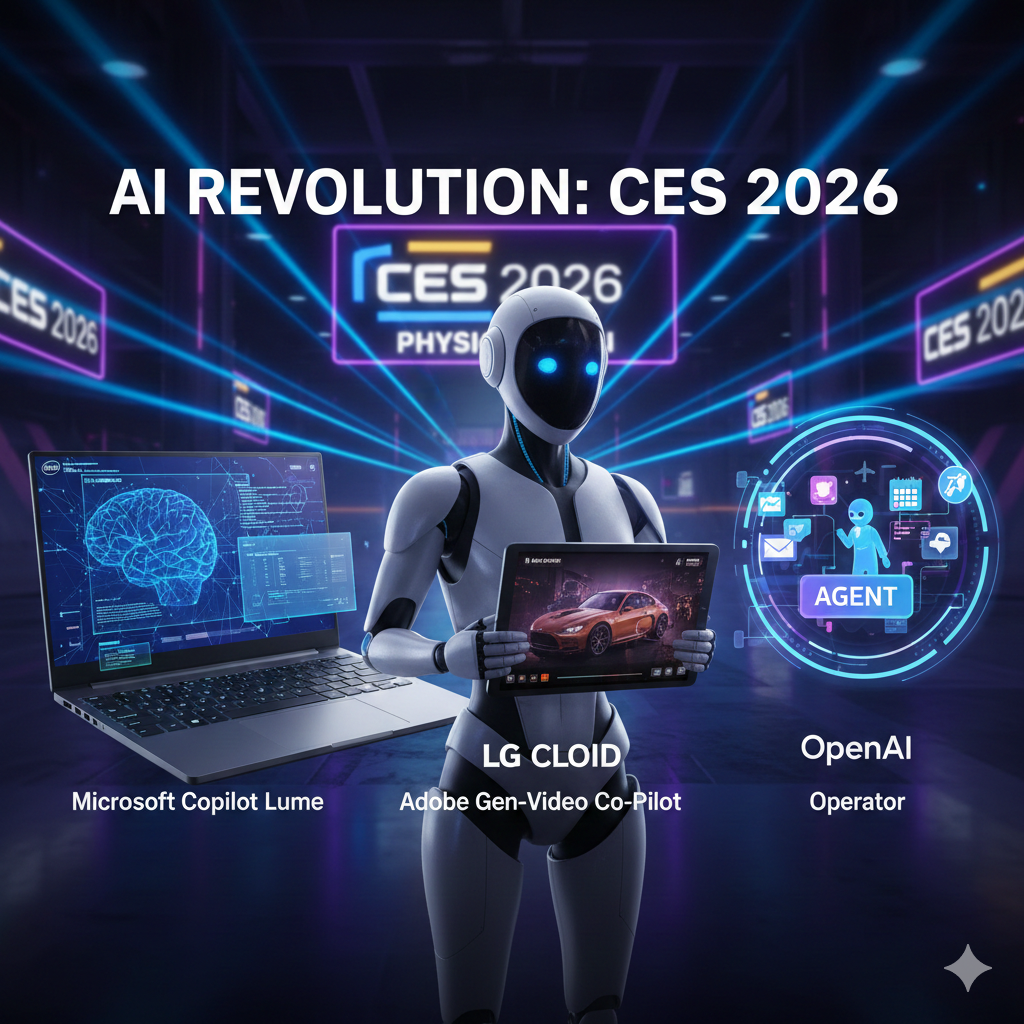
The Consumer Electronics Show (CES) 2026 has officially marked the end of the “Chatbot Era.” For the last two years, we marveled at AI’s ability to talk; in 2026, we are witnessing AI’s ability to act. The theme of this year’s software showcase is “Agentic Workflows”—AI tools that don’t just suggest solutions but execute them autonomously.
In this detailed analysis, we compare the three titans of the show: OpenAI’s ‘Operator’, Microsoft’s ‘Copilot Lume’, and Adobe’s ‘Gen-Video Co-Pilot’.
1. OpenAI ‘Operator’: The Dawn of the Personal Agent
For years, OpenAI was synonymous with ChatGPT. At CES 2026, they unveiled Operator, a tool that shifts the paradigm from “Large Language Models” (LLM) to “Large Action Models” (LAM).
Technical Infrastructure
Operator is built on the GPT-5.5 backbone, optimized specifically for browser-based navigation and API interaction. Unlike previous versions that required plugins, Operator uses Computer-Use Vision. It “sees” your screen just like a human does, identifying buttons, text fields, and checkout toggles.
Key Capabilities
- Cross-Platform Execution: You can give a command like, “Find a flight to Tokyo under $900, book it using my saved card, and message my boss on Slack that I’ll be OOO.” Operator executes this across three different platforms (Expedia, Chrome, and Slack) without you clicking a single button.
- Reasoning and Error Handling: If the flight price jumps during the booking process, Operator doesn’t crash. It pauses, searches for the next best option, and asks for a one-tap confirmation.
- The “Ghost Mode” Privacy Layer: To address massive privacy concerns, OpenAI introduced a local-only processing mode where sensitive data (CCVs, passwords) never leaves the user’s device.
2. Microsoft Copilot ‘Lume’: The Developer’s New Brain
While OpenAI is targeting the general consumer, Microsoft used CES 2026 to solidify its grip on the professional and developer market with Copilot Lume.
From Auto-Complete to Auto-Architect
Lume is not just an upgrade to GitHub Copilot; it is a full-scale Software Engineer in a Box.
- Repository-Wide Context: Most AI coding tools only understand the file you are currently looking at. Lume scans your entire 10,000-file repository in seconds. If you change a variable in the backend, Lume automatically suggests the necessary updates for the frontend and the database schema.
- Predictive Debugging: Using “Speculative Execution,” Lume runs your code in a virtual sandbox in the background. It flags bugs before you even hit ‘Save’.
- Natural Language Infrastructure: Lume allows non-technical founders to describe an app idea in English, and it generates the Docker containers, Kubernetes clusters, and React components automatically.
3. Adobe Gen-Video Co-Pilot: The Death of the Boring Timeline
Adobe’s presence at CES 2026 was focused on one thing: Generative Video Control. While tools like Sora and Runway create videos from scratch, Adobe’s Gen-Video Co-Pilot focuses on editing existing footage with surgical precision.
The “Object Manipulation” Breakthrough
The most talked-about feature is Generative Extend & Swap.
- Scene Relighting: You can take a video shot at noon and tell the AI to “Make it look like a rainy evening in London.” The AI recalculates every shadow and reflection on moving objects (like cars or water puddles).
- Dynamic B-Roll: The AI analyzes your audio transcript and automatically generates 4K B-roll footage that matches your brand’s specific color grade and style, saving editors days of searching through stock libraries.
4. The Grand Comparison: Which AI Tool Wins?
To help you understand which tool fits your workflow, we have broken down the technical differences:
Feature | OpenAI Operator | Microsoft Copilot Lume | Adobe Gen-Video Co-Pilot |
Primary Goal | Task Automation (The “Doer”) | Code & Logic (The “Builder”) | Content Creation (The “Artist”) |
Core Tech | Large Action Model (LAM) | LLM + Speculative Debugging | Firefly Video Model |
User Interface | Voice & Browser Overlay | IDE Integration (VS Code) | Premiere/After Effects Plugin |
Target User | General Public & Executives | Developers & Data Scientists | Creators & Filmmakers |
Biggest Strength | Handles “Real World” Logistics | Deep System Understanding | Visual Consistency |
Privacy Rating | High (Ghost Mode) | Enterprise Grade (Azure) | Proprietary/Copyright Safe |
5. Strategic Analysis: Impact on the Global Economy
The tools launched at CES 2026 represent a $3.5 Trillion shift in the digital economy.
The Displacement of “Middle-Ware” Apps
If OpenAI’s Operator can book flights, order food, and manage emails, the need for individual apps (like Uber, Expedia, or Outlook) to have their own UI decreases. We are moving toward a “Headless Internet” where we interact with one AI agent, and the apps live in the background.
The 10x Developer and 10x Creator
Microsoft Lume and Adobe Gen-Video are turning “Junior” workers into “Senior” workers overnight. A single developer can now manage a codebase that previously required a team of five. A solo YouTuber can now produce a documentary with the production value of a Netflix special.
6. Challenges and Ethics: The Shadow Side of CES 2026
No 1500-word analysis is complete without addressing the risks.
- The Autonomy Risk: If an AI Agent (Operator) makes a mistake in a financial transaction, who is liable?
- Copyright Integrity: Adobe is leading the way with “Content Credentials,” but as AI-generated video becomes indistinguishable from reality, the risk of deepfakes remains a primary concern for 2026.
- The Hardware Gap: These AI tools require massive compute. CES 2026 showed us that while the software is ready, users will need to upgrade to NPU-heavy hardware (like Intel’s Panther Lake) to run these tools locally and privately.
Conclusion: The New Normal
CES 2026 has proven that AI is no longer a toy or a novelty. OpenAI Operator is your new personal assistant, Microsoft Lume is your lead engineer, and Adobe Gen-Video is your production house.
The winners of 2026 won’t be those who “use” AI, but those who effectively delegate to it. The “Physical AI” we see in robots is impressive, but the “Digital AI” in these tools is what will change your bank account and your schedule today.

With years of experience in career guidance and skill development, Kapil shares practical insights on AIToolClouds.com, a platform designed to empower professionals, students, and freelancers with valuable knowledge.