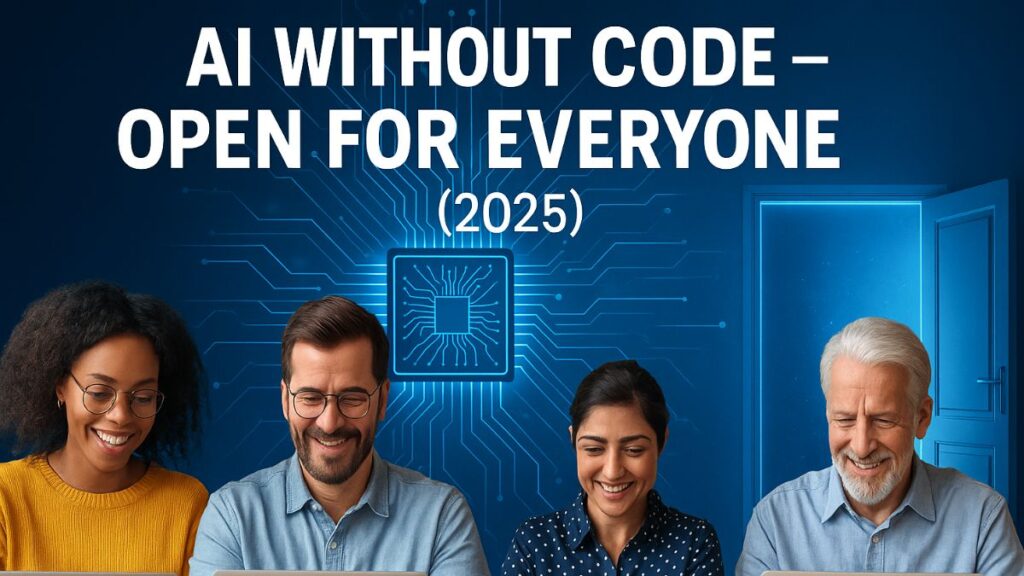
Artificial Intelligence, once a domain reserved for developers and data scientists, is now stepping into the hands of everyday people. Thanks to no-code AI platforms, voice-based tools, and intuitive design systems, 2025 is shaping up to be the year when AI becomes truly accessible to all.
AI Without Coding: A Quiet Revolution
For years, building an AI model meant knowing complex programming languages and frameworks like Python, TensorFlow, or PyTorch. But today, platforms such as Google Vertex AI, Microsoft Azure AI Studio, and Runway ML are enabling users to create powerful AI applications using drag-and-drop interfaces and plain English instructions.
In other words, you no longer need to code to teach a machine how to think — you simply tell it what to do.
Experts are calling it the “democratization of AI,” a movement that’s allowing small businesses, creators, educators, and even students to use AI like professionals — no technical background required.
From Creators to Classrooms: Everyone’s Using AI
The biggest transformation is visible in content creation and education.
Students now use ChatGPT, Claude, and Gemini to write essays, solve equations, or translate complex scientific concepts into simple explanations.
Creators use tools like Pika Labs and Runway ML to generate cinematic videos from text prompts — without a single line of code.
In classrooms, teachers are building personalized lesson plans using AI assistants. In offices, marketers and HR teams are creating predictive models and automated dashboards — all powered by no-code AI interfaces.
“This is not just a technology shift; it’s a social shift,” said Dr. Priya Mehta, AI educator at IIT Delhi.
“We’re watching artificial intelligence become part of everyday problem-solving, like spreadsheets once did in the 90s.”
The Rise of No-Code Platforms
The no-code AI movement is being driven by companies that are simplifying the hardest part of AI — model training and deployment.
Here are some notable players reshaping the field:
- Google Vertex AI: Offers pre-built models and easy workflows for businesses.
- Runway ML: Allows creators to generate videos, images, and designs with text prompts.
- Akkio: Empowers non-technical teams to create prediction models from Excel sheets.
- Notion AI and ChatGPT: Give individuals access to reasoning, planning, and writing capabilities instantly.
This shift has created an entirely new industry segment — “AI as a Service for Everyone,” where users pay small monthly fees to use high-end AI capabilities without writing a single line of code.
Empowering Small Businesses and Startups
For small businesses, this accessibility means competing with tech giants.
Shop owners are using AI chatbots to handle customer queries, freelancers are building AI-driven websites, and small startups are creating data analysis tools without hiring developers.
A single entrepreneur can now automate inventory tracking, customer support, and marketing campaigns — all from their laptop.
This democratization is flattening the digital divide, allowing innovation to come from anywhere — not just Silicon Valley.
Bridging the AI Divide Globally
AI’s accessibility is also changing global inclusion.
Emerging markets like India, Brazil, and Indonesia are now witnessing the rise of local AI innovation — where developers build tools in their native languages.
Google’s Gemini, OpenAI’s ChatGPT, and Anthropic’s Claude have all introduced multilingual support, breaking language barriers that once excluded millions from using AI.
As a result, people in rural areas can now generate content, translate documents, or even automate local business operations using natural language in Hindi, Tamil, or Bengali.
“AI is becoming like electricity — invisible but essential,” said Ramesh Kapoor, co-founder of an AI startup in Bengaluru.
“No-code AI has turned regular people into innovators.”
Challenges Still Remain
Despite the enthusiasm, experts warn of overreliance and lack of understanding.
While no-code AI removes technical hurdles, it can also make users unaware of data bias, ethical issues, and algorithm transparency.
Governments and institutions are now working on frameworks to ensure responsible AI use, especially as these systems become mainstream.
Still, the benefits outweigh the risks. As one analyst from Gartner put it:
“The future belongs not to those who can code, but to those who can think and guide machines responsibly.”
A Future Without Barriers
The story of AI in 2025 isn’t about machines taking over — it’s about machines empowering more humans.
No-code platforms are transforming the once-elite world of artificial intelligence into a global playground for creativity and productivity.
From classrooms to boardrooms, from freelancers to farmers — AI is now accessible to all.
The barriers have fallen; what remains is imagination.

With years of experience in career guidance and skill development, Kapil shares practical insights on AIToolClouds.com, a platform designed to empower professionals, students, and freelancers with valuable knowledge.