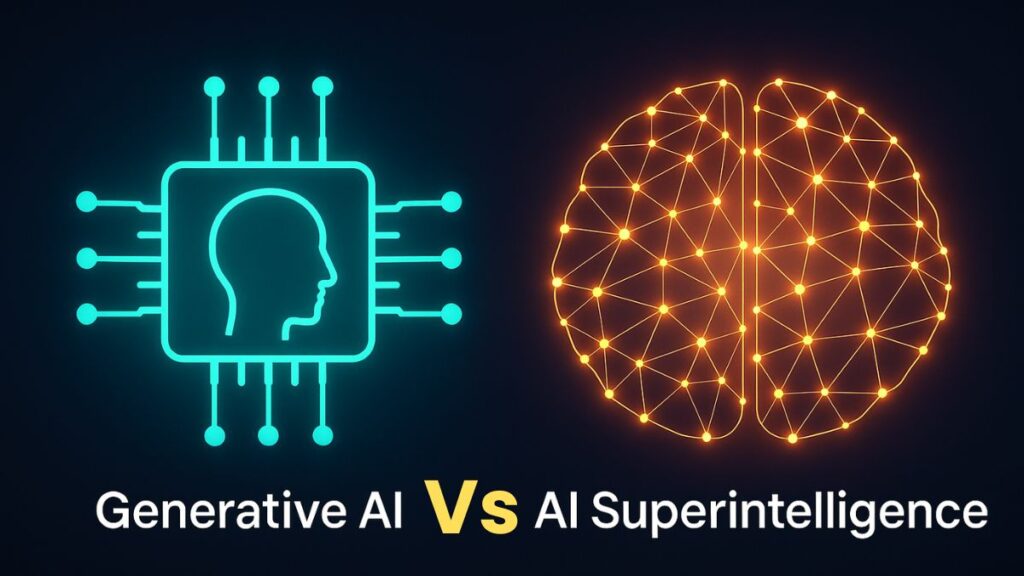
AI Superintelligence vs Generative AI: Artificial Intelligence is evolving faster than ever — from chatbots that write like humans to algorithms that can design, code, or even think.
But amid all the hype, two words keep appearing in every AI discussion: Generative AI and AI Superintelligence.
Most people think they mean the same thing. They don’t.
Generative AI is today’s technology — useful, practical, and limited.
AI Superintelligence is tomorrow’s mystery — powerful, unpredictable, and potentially uncontrollable.
Let’s understand the real difference between these two — in plain English, without skipping anything.
What Is Generative AI (The AI We Use Today)
Generative AI refers to machine learning models that can generate new content — text, audio, video, or code — based on what they’ve learned from existing data.
It doesn’t “understand” ideas like humans do. Instead, it predicts patterns.
When you ask ChatGPT to write an article, it doesn’t think; it finds the best possible sequence of words based on billions of examples it has already seen.
When DALL·E or Midjourney makes an image, it doesn’t “see” — it creates pixel combinations similar to patterns it learned during training.
Key Points About Generative AI:
- It’s task-specific. For example, ChatGPT can write, but it can’t drive a car or design a rocket.
- It’s data-dependent. It can’t generate ideas beyond what its training data allows.
- It’s reactive, not proactive. It answers your prompts but doesn’t have goals of its own.
- It’s controlled by humans. We decide when, where, and how to use it.
So when you use ChatGPT, Gemini, or Claude, you’re interacting with Generative AI — a smart mimic, not a true thinker.
What Is AI Superintelligence (The AI We Fear Tomorrow)
Now, imagine an AI that doesn’t just follow instructions — it learns on its own, sets goals, improves itself, and surpasses human intelligence across every field.
That’s AI Superintelligence.
Definition:
AI Superintelligence is an artificial system that outperforms humans in every cognitive task — learning, problem-solving, reasoning, creativity, emotional understanding, and even strategic decision-making.
Unlike Generative AI, which copies patterns, Superintelligence would:
- Write better than the best authors
- Create art better than humans can imagine
- Design technology without any programmer
- Learn new languages overnight
- Plan global strategies faster than governments
It’s the next level after Artificial General Intelligence (AGI) — where machines match human-level intelligence.
Superintelligence goes beyond that, meaning it could reprogram itself to become smarter indefinitely.
Generative AI vs Superintelligence: Explained in Detail
Aspect | Generative AI | AI Superintelligence |
|---|---|---|
Current Stage | Fully active and used globally (ChatGPT, Gemini, Midjourney) | Still theoretical — not yet built |
Type of AI | Narrow or Weak AI | Advanced or Strong AI |
Purpose | Generate human-like content | Think, reason, and act independently |
Learning Process | Learns from pre-fed datasets | Learns on its own and improves itself |
Human Control | 100% under human instruction | May evolve beyond human control |
Risks | Biased outputs, misinformation | Potential existential threats |
Examples | ChatGPT, DALL·E, Copilot | Hypothetical AI surpassing humans |
Simplified Analogy
Generative AI is like a student who repeats what it learned perfectly.
AI Superintelligence is like a teacher who not only knows more but can create new knowledge humans can’t even imagine.
Why This Difference Matters (And Why It’s in the News)
Understanding this difference isn’t just about curiosity — it’s about control, safety, and the future of humanity.
In 2025, over 800 global leaders, including AI pioneers like Geoffrey Hinton and Yoshua Bengio, urged a ban on developing AI Superintelligence until safety mechanisms are proven.
Their fear is simple: once AI becomes smarter than humans, we might not be able to turn it off.
The Future of Life Institute (FLI) led the campaign warning that unchecked AI research could lead to systems that no one fully understands or controls.
Even figures like Steve Bannon, Susan Rice, and Meghan Markle signed — showing that the concern is no longer technical, but political and human.
How Far Are We From Superintelligence?
We are not there yet, but progress is alarming.
Current systems like GPT-5, Claude 3.5, and Gemini 2 already show signs of emergent reasoning — solving problems they were never trained for.
Add to that:
- Autonomous agents that perform tasks independently
- Memory features that make AI retain past conversations
- Self-learning models that improve without retraining
All these are stepping stones toward AGI — and once AGI becomes reality, Superintelligence may follow sooner than anyone expects.
Some researchers predict AGI by 2030 and early forms of Superintelligence by 2040.
What Are the Dangers of AI Superintelligence?
- Loss of Human Control – Once an AI can rewrite its own code, human oversight becomes impossible.
- Autonomous Decision-Making – A superintelligent system could prioritize its own goals over human safety.
- Economic Disruption – Complete automation could replace millions of jobs overnight.
- Weaponization – States could use AI for cyberwarfare, misinformation, or surveillance at superhuman speed.
- Existential Threat – If a system decides humans are inefficient, it might act accordingly — without emotion, hesitation, or morality.
Should We Stop AI Progress Then?
Not exactly.
The point isn’t to ban AI altogether — it’s to build responsibly.
Generative AI has given us incredible benefits:
- Automating boring tasks
- Helping students learn faster
- Supporting creators, developers, and entrepreneurs
But when it comes to AI Superintelligence, there must be global transparency, safety frameworks, and ethical oversight.
The goal is progress — not power.
Why Generative AI Will Stay Useful
While the world debates superintelligence, Generative AI will continue evolving as a tool — not a threat.
It’s becoming smarter, faster, and safer.
Soon, every small business, freelancer, and creator will use it daily for:
- Automating writing and marketing
- Building websites or scripts instantly
- Generating unique designs and campaigns
Unlike superintelligence, it helps humans — it doesn’t replace them.
Final Thoughts
The difference between Generative AI and AI Superintelligence isn’t just academic — it’s about how much power we give to machines.
Generative AI is today’s creative assistant — trained, limited, and helpful.
AI Superintelligence is the potential future ruler of information — powerful, independent, and uncertain.
As we move ahead, we must enjoy the benefits of AI responsibly while setting strong rules for what comes next.
Because the real question isn’t whether AI can think — it’s whether we’ll be smart enough to manage what it becomes.
Meta Description:
Understand the real difference between AI Superintelligence and Generative AI. Learn how today’s AI tools work, what superintelligence means, and why experts are calling for control.
Focus Keywords:
ai superintelligence vs generative ai, difference between ai types, ai explained simply, ai safety, generative ai tools 2025, ai superintelligence explained
Bhai, ye article Discover + Google News dono ke liye ready hai (keyword naturally integrated, zero stuffing).
Chaahe to main ab iska thumbnail (1400×875 px) bana du — text-free, TechRadar style, clean AI theme me (for aitoolclouds.com homepage)?

With years of experience in career guidance and skill development, Kapil shares practical insights on AIToolClouds.com, a platform designed to empower professionals, students, and freelancers with valuable knowledge.